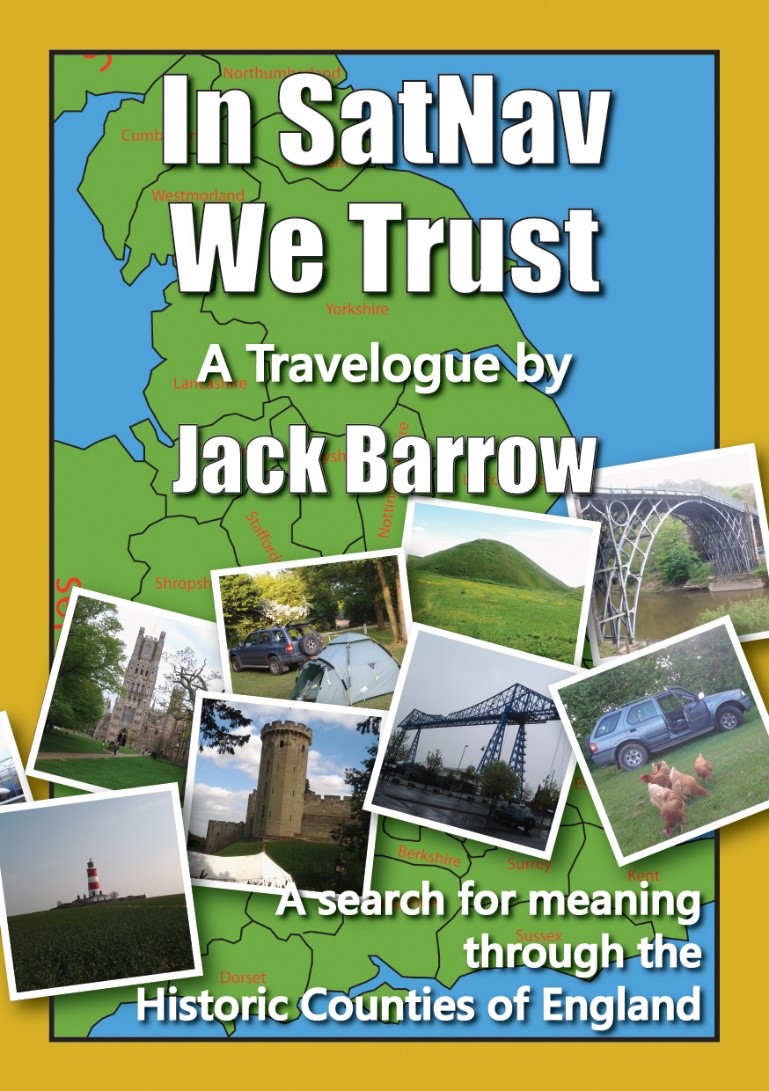
In SatNav We Trust is an entertaining and philosophical romp around the Historic Counties of England by Jack Barrow as he travels with his troublesome navigator Kathy (actually his SatNav – the voice of Radio 4’s Kathy Clugston), thinking about counties and boundaries that have disappeared, mulling the universe and searching for enlightenment.
Along the way, on his 3000 mile journey around England, Jack wonders if the straight road out of Thame was borne out of a Roman invasion or a petulant government directive. Channelling a little bit of Douglas Adams, a dash of Nick Hornby even some Evelyn Waugh, this travelogue takes in the castles, cathedrals and feats of engineering along the way as our narrator searches for meaning adopting a balanced approach that draws on the great literary thinkers while mining the dividing line between science and religion.
The book finds humour in everyday challenges and neuroses like the roulette game of taking a shower on a campsite or trying to fully charge your devices without an electrical hook up. It asks questions such as how do you get off a powerful speedboat when there are two drunk blokes in charge and the tide is going out or why did you choose a salad for lunch when chips might be really what you desire?
It is also an exploration of whether we knew better in the pre-Internet days, when going in search of knowledge we could go to the library and look something up in old newspaper cuttings, yet we would still accept the testimony of a random stranger to explain the origins of an ancient landmark.
It sums up our modern day experience by throwing caution to the SatNav and surrendering to it as it dictates where to go, only to constantly over-ride its instructions and end up in a dysfunctional co-dependent relationship with it because a regular road map wouldn’t give you the finer detail of the roads less travelled.
So if you have ever pondered the meaning of meaning, come to the realisation that you don’t have to travel far to begin questioning your place in the universe, and are intrigued to know how a compass, the Large Hadron Collider and a dreamcatcher might be connected, read this book.
One thing is for sure, it is well worth taking the leap of faith and landing in the middle of this reflective, unreliable narrator, because you will gain knowledge, smile a lot and even laugh out loud.
Along the way, on his 3000 mile journey around England, Jack wonders if the straight road out of Thame was borne out of a Roman invasion or a petulant government directive. Channelling a little bit of Douglas Adams, a dash of Nick Hornby even some Evelyn Waugh, this travelogue takes in the castles, cathedrals and feats of engineering along the way as our narrator searches for meaning adopting a balanced approach that draws on the great literary thinkers while mining the dividing line between science and religion.
The book finds humour in everyday challenges and neuroses like the roulette game of taking a shower on a campsite or trying to fully charge your devices without an electrical hook up. It asks questions such as how do you get off a powerful speedboat when there are two drunk blokes in charge and the tide is going out or why did you choose a salad for lunch when chips might be really what you desire?
It is also an exploration of whether we knew better in the pre-Internet days, when going in search of knowledge we could go to the library and look something up in old newspaper cuttings, yet we would still accept the testimony of a random stranger to explain the origins of an ancient landmark.
It sums up our modern day experience by throwing caution to the SatNav and surrendering to it as it dictates where to go, only to constantly over-ride its instructions and end up in a dysfunctional co-dependent relationship with it because a regular road map wouldn’t give you the finer detail of the roads less travelled.
So if you have ever pondered the meaning of meaning, come to the realisation that you don’t have to travel far to begin questioning your place in the universe, and are intrigued to know how a compass, the Large Hadron Collider and a dreamcatcher might be connected, read this book.
One thing is for sure, it is well worth taking the leap of faith and landing in the middle of this reflective, unreliable narrator, because you will gain knowledge, smile a lot and even laugh out loud.
The In SatNav We Trust book is £8.49 and is available from online booksellers or high street bookshops