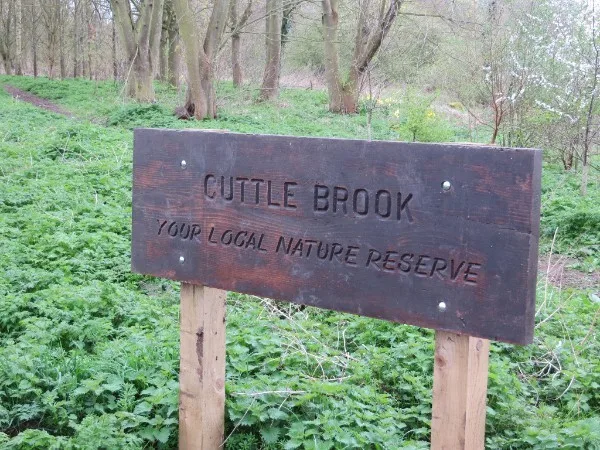
Winter into early spring is usually the busiest time for the Cuttle Brook volunteers, and this season has been no exception. The work to replant Cox’s Wood, after the ash-dieback clearance, has continued, with 80 or so trees being planted with the help of members of Thame Belles WI. While this terrible disease is continuing to decimate our ash trees, which are such an important part of our woodland landscape, we can take a positive from the fact that this imposed clearance has provided an opportunity to add some age diversity into the wood. It is no longer an even-aged plantation with all of the trees at the same stage in their lifecycles. Having trees of different ages and different sizes provides a lot more habitat diversity for a wider range of woodland creatures.
Related to the limited age range of trees on the reserve is the relative lack of nesting and roosting opportunities for birds and bats. With the generous help of Lucy Electric, we have been able to purchase and put up 18 desirable new residencies for Cuttle Brook songbirds. The boxes, purchased through the RSPB, are a combination of traditional wood construction and more robust ‘woodcrete’ boxes that we hope will be resistant to squirrels and woodpeckers. Satisfyingly, a great tit was seen investigating one of the boxes within 20 minutes of it being erected, so we are optimistic of getting good take-up.
This winter-spring has also seen us complete a topographical survey of the brook through the reserve as far as the Oxford Road. This is one of those jobs that only reveals its true nature when you are up to your chest in freezing water and struggling through overgrowth with a 5-metre ranging pole. But after 6 sessions a determined band of surveyors has now got elevation data for the brook bed from the Phoenix Trail to the Oxford Road – data that will be invaluable for guiding future improvements for biodiversity in the brook; biodiversity that ultimately supports the three otters recently photographed on the reserve.